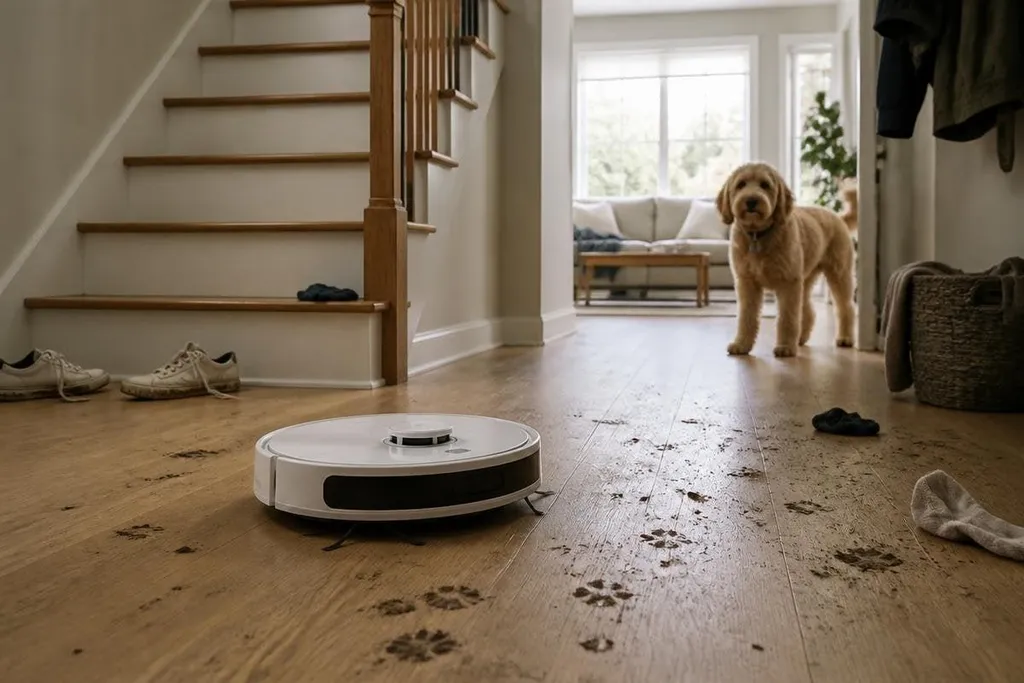
A home robot will need to handle clutter, pets, stairs, people, and changing light before it can do useful work without help. That makes household robots a harder engineering problem than a clean demo suggests, even when the task looks simple.
The first machines people keep will likely focus on narrow jobs, such as floor cleaning, lawn care, or carrying items between fixed points. Trying to handle every room and every object would expose a robot to too many unknowns at once.
Quick read
- Home robots need safe movement around people, pets, furniture, and loose objects.
- Narrow jobs are easier to test and explain than general household work.
- Charging, repair, privacy, and failure recovery will shape ownership as much as movement.
Why homes are hard for robots
Factories give robots fixed floors, known objects, marked work areas, and controlled access. Homes give them low tables, soft bags, cables, glassware, door thresholds, and objects that move between rooms. A robot has to sense the space before it can act in it.
That sensing may use cameras, depth sensors, LiDAR, or several systems together. The robot needs to tell a chair from a person, a toy from rubbish, and a wet patch from a dark floor. Each mistake has a direct effect on safety or on the work you expected it to do.
The problem changes when someone moves a chair or leaves a bag in a passage. The robot must build and update a map of the room, then choose a safe path around the new obstacle.
It also needs a clear response when it cannot identify an object or reach a target. A useful home robot will need to stop and ask for help at the right time. That sounds less impressive than acting alone, but a clear pause is safer than a machine that carries on with a bad guess.
The first jobs will stay narrow
Cleaning robots already show why narrow tasks make sense. A floor robot can repeat a defined route and return to a charging dock, while a general-purpose machine would need to pick up objects before it could clean beneath them.
The same pattern applies to outdoor work, item delivery inside a home, and simple monitoring. These machines can work well when their task, tools, and operating area stay within limits that engineers can test.
General household work needs many skills at once. Picking up a towel calls for object recognition, a suitable grip, force control, balance, and a place to put the towel. A small error in any one part can stop the task.
That is why a robot with fewer jobs may be the better product. You can judge it by a clear result, such as whether it reaches a set area or carries a known item without help.
Ownership will decide the market
Movement alone won't decide if people keep a home robot. The machine must charge without blocking a doorway, recover from a stuck wheel, accept software updates, and tell you what went wrong in plain language.
Repair also matters. A broken sensor or worn gripper can turn a useful robot into an expensive object on the floor. Makers will need to explain service costs, spare parts, battery replacement, and the time a repair takes before people can judge the real price.
Privacy brings another limit. Cameras and microphones can record rooms, voices, and daily routines, so buyers need clear settings for storage, access, and deletion. A robot that works well but gives people no control over household data will face a basic trust problem.
Data controls only count when a buyer can see what gets stored, who can access it, and how deletion works. Home robotics reporting from Robot24.com can connect those settings to named machines and test dates before the next section asks what still needs proof.
What still needs proof
Many home-robot claims depend on demonstrations under conditions chosen by the maker. A video can show a successful task without showing how often the robot fails, how long setup takes, or what happens after a person changes the room.
The useful tests will be plain. Can the robot repeat the job across different homes? Can it recover without a technician? Can it work near children and pets under a clear safety process? Can the owner understand and fix a failure?
A careful buyer should ask for those details before paying for a machine that promises broad household help. I’d wait for repeated home trials and clear repair terms before buying a general-purpose home robot.
A practical buying checklist
Use these checks when a home robot reaches the market:
- Name the job: Write down the one task you want completed and the room where it must work.
- Check the limits: Ask which surfaces, objects, stairs, pets, and lighting conditions the robot can handle.
- Watch the failure case: Find out what happens when the robot gets stuck, loses an object, or cannot identify its target.
- Price the upkeep: Include charging equipment, software fees, service visits, batteries, and replacement parts.
- Review privacy controls: Check what the robot records, where data is stored, and how you delete it.
Home robots will become useful one job at a time, if makers show repeatable work instead of isolated success. The open question is whether a robot can save enough effort to justify the space, price, and supervision it still needs.